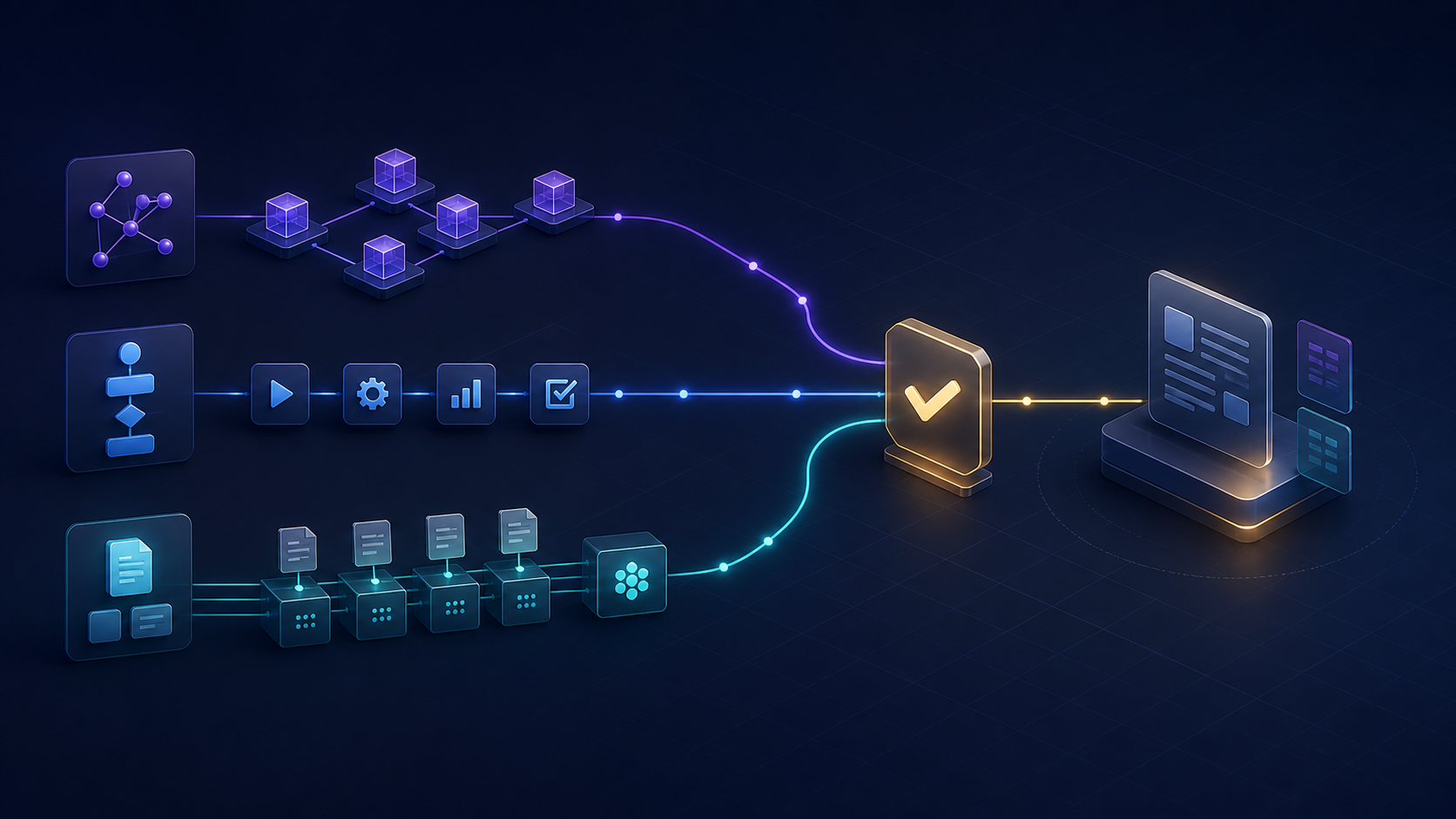
Choose Dify when the product is a knowledge-backed AI application. Choose n8n when AI is one step inside a larger business automation. Choose Langflow when a developer wants a visual model-and-component graph exposed through an API. They overlap, but they are not interchangeable “AI workflow builders.”
That distinction matters more than a feature checklist. Dify, n8n, and Langflow can all connect models and tools, yet they put different responsibilities in front of the operator: application and knowledge design, integration and execution operations, or graph composition and deployment. This guide turns those differences into a decision you can defend.
Scope: this is an evidence-based architecture comparison from official documentation, licenses, deployment files, and release surfaces checked on September 8, 2026. It is not a hands-on installation, performance benchmark, security audit, or claim that HiseHub ran the same workflow on all three.
Quick answer: which one should you choose?
| If your main need is… | Start with… | Because… | Reconsider when… |
|---|---|---|---|
| A user-facing AI app grounded in a named knowledge base | Dify | Its visual Workflow/Chatflow model, Knowledge Retrieval node, model-provider workspace, run history, and Human Input node line up with that job. | You need extensive SaaS connectors, business event routing, or a pre-existing automation team. |
| Moving data between services, APIs, schedules, and approvals | n8n | Its centre of gravity is workflow orchestration, credentials, execution history, error workflows, retries, and a wide integration surface. | The main product is an AI/RAG application rather than an integration around one. |
| A developer-controlled visual graph and API endpoint | Langflow | Its flows are composed from components and exposed through documented run endpoints, with Docker/PostgreSQL deployment paths. | You need a ready-made review inbox, document product, or business-process connector layer. |
| The lowest operational burden | Possibly none | Self-hosting trades subscription convenience for backups, secrets, upgrades, monitoring, and incident response. | You cannot rehearse a restore or own the provider/API data path. |
The answer is deliberately conditional. There is no honest single winner without knowing whether the “workflow” is an AI application, an integration, or a developer graph. For the wider self-hosted landscape, see the Self-Hosted AI Tools directory. The earlier Open WebUI vs LibreChat vs LobeHub comparison covers interface/workspace choices; this article compares the orchestration layer behind a repeatable task.
What each product is actually optimising for
Dify: an AI application and knowledge workflow
Dify’s official documentation describes Workflow and Chatflow as visual canvases that combine models, tools, logic, and repeatable steps. A Workflow runs once from input to output; a Chatflow starts from a user message. A workflow can begin from user input or a trigger, then branch, call tools, retrieve knowledge, invoke an LLM, and return an output. That is an application-shaped abstraction rather than a generic “connect every SaaS” canvas. See the official Workflow & Chatflow guide.
The Knowledge Retrieval node is a particularly important differentiator. It searches selected knowledge bases, returns chunks and metadata, and passes them to a downstream LLM; reranking and metadata filters are configurable. This does not mean a new self-hosted Dify instance already contains your documents or a vector index. You still choose how to import, chunk, index, store, update, and delete the source material. The official Knowledge Retrieval documentation is the right reference for that boundary.
Dify also makes model credentials a workspace concern. The Model Providers guide says a provider must be installed and configured with an API key before its models are available, and distinguishes LLM, embedding, rerank, speech, and other roles. In other words, self-hosting Dify does not include a model or make a cloud provider’s consumer subscription usable through an API.
n8n: an automation and integration engine with AI nodes
n8n starts from a different question: “Which event should move data through which services, and what happens when a step fails?” Its official documentation calls it a fair-code workflow automation tool that connects apps and APIs, while also documenting AI agents, tools, models, vector stores, and retrieval-related nodes. That makes n8n compelling when the AI step is one stage in a larger process—ticket intake, CRM update, approval, notification, and archive—rather than the whole product.
Operations are part of the product model. n8n stores credentials for external services, records executions, can retry failed workflows from execution history, and supports an Error Workflow that begins with an Error Trigger. The error-handling documentation is useful precisely because it does not imply that every failure should be silently retried: the operator decides how to alert, stop, compensate, or recover.
Scaling also changes the shape of a deployment. The official queue-mode guide describes a main instance, Redis, a database, and workers. It also notes that filesystem binary storage is not supported in queue mode, so a workflow that needs durable binary data has another storage decision. You do not need queue mode for a small setup, but it is a reminder that a “workflow builder” can become an operations system.
Langflow: a visual graph and execution API
Langflow is most naturally understood as a component graph that a developer can run and expose. Its official API documentation shows flows being invoked through /v1/run/$FLOW_ID or webhook endpoints, and the API can create, read, update, and delete flows. The graph can contain model, retrieval, memory, transformation, and custom components, but the final data path depends on the components and services you choose.
The deployment story is explicit. The Docker guide covers a quick container, Docker Compose with persistent PostgreSQL, packaging flows into an image, and upgrading while reattaching volumes. The authentication guide warns against exposing ports directly, explains API keys and user authentication, and says a key inherits the permissions of its creator. That is powerful for an internal API and a risk if keys are treated as harmless demo tokens.
Langflow’s global variables are stored in its internal database and encrypted with a secret key, according to the global variables documentation. This is a useful credential boundary, but it is not a promise that the model or connected service is local. A flow can still send data to any configured provider, vector store, web service, or custom component.
One fictional task, three implementation paths
To make the comparison concrete, use the same example throughout. A customer asks:
“Which of our three published plans includes document retrieval, and what should we warn about before enabling it?”
The input is sent to a workflow; it retrieves only from a named set of public plan pages; a model drafts an answer with source references; a human checks it; then the approved answer is delivered and archived. The example is fictional. It uses no real customer record, mailbox, or outbound message.
The Dify route: application-first
- Start with User Input or a documented trigger.
- Use Knowledge Retrieval against a selected knowledge base, with metadata filters if plan or publication boundaries matter.
- Pass the retrieved result into an LLM node with a prompt that requires “not found” when the sources do not support an answer.
- Send the draft to Human Input. The reviewer can approve, request a revision, or reject it; a timeout branch can notify an owner or stop the run.
- Return the approved result through Output or a separately configured API/archive step.
This is the shortest documented single-workspace model for a retrieval-backed AI application. It still needs a model-provider credential, an indexed knowledge base, storage, access policy, and a delivery/archive integration. If the workflow starts from a trigger, check the documentation for the selected Human Input delivery method: the web-app form is not available for trigger-started workflows.
The n8n route: integration-first
- Receive the question through a webhook, form, ticket, schedule, or another service trigger.
- Use an HTTP/vector-store/retriever path that you configure, with an embedding model and document store chosen for the deployment.
- Call an AI Agent or model node to draft an answer and carry the retrieved evidence as structured data.
- Use a Wait/approval pattern or n8n’s documented human-in-the-loop tool review, sending approval to a configured channel such as Slack, Discord, Telegram, Teams, or n8n Chat.
- On approval, deliver and archive. On rejection, route back to a revision branch; on timeout or error, alert an owner and leave the original execution trace intact.
n8n is attractive when this question is only one event in a larger business process. The trade-off is a larger integration surface: credentials, webhook security, rate limits, idempotency, retries, message delivery, and the chosen retrieval stack become your responsibility. “n8n supports AI” is not the same as “n8n has already designed your RAG policy.”
The Langflow route: graph/API-first
- Build a flow with input, document loader or retriever, model, formatter, and explicit output components.
- Expose the flow through the documented run API and protect it with authentication.
- Have a small application or an external workflow call the flow, display the draft and evidence, and collect the human decision.
- Call the flow again for a revision if the reviewer requests one, then store the approved answer in the application’s archive.
This path gives a developer control over the graph and API boundary, but the approval inbox, delivery logic, retries, and archive are not presented here as a universal built-in Langflow feature. They are surrounding application work unless the selected components and deployment provide them. That is a strength for a software team that wants a composable backend, and a cost for someone hoping to configure a finished business process in one console.
What happens when the workflow fails?
The happy path is not the decision. A useful comparison asks what happens when evidence is missing, a model times out, an event is delivered twice, or a reviewer rejects the draft.
| Failure | Dify | n8n | Langflow |
|---|---|---|---|
| No supporting passage is retrieved | Make the prompt and branch treat the result as “insufficient evidence”; a Human Input or fallback path can stop delivery. | Set an explicit empty-result branch before the model/delivery nodes; the retriever and store are selected components. | Return a structured empty-evidence state from the graph and let the calling app stop or request review. |
| Model/API timeout | Use the documented run history and error/fallback logic; retry only when the request is safe to repeat. | Use execution history, Error Workflow, and controlled retry/alert logic. A blind retry can duplicate side effects. | Handle the API error at the flow or caller boundary; retry/backoff and idempotency are design work. |
| Duplicate trigger | Use an idempotency key or a dedupe step in the workflow/application. | Persist the event ID and use a dedupe branch before sending a message; webhook delivery is not proof of uniqueness. | Have the caller or persistence layer record an execution key; the flow endpoint alone does not define business idempotency. |
| Reviewer rejects the draft | Route the Human Input decision to revision, escalation, or stop. | Pause at human review and route the result to a revision, alternate approver, or dead-letter/archive path. | Return the draft and decision to the surrounding app, which calls a revision graph or closes the case. |
Dify and n8n have particularly explicit documentation for human review/error paths. That does not mean Langflow cannot implement them; it means this comparison will not turn a composable API into a promise of a built-in approval product. Every system still needs a no-send rule: do not deliver a customer-facing answer when the evidence is empty, the approval is missing, or the request has already been processed.
Credentials, data, and backups
“Self-hosted” describes where the application is deployed, not where every prompt, file, embedding, or output travels. A realistic path can include:
- the browser or triggering service;
- the workflow application and its logs;
- document extraction and chunking;
- an embedding model and vector database;
- the selected LLM provider or a local runtime;
- the approval channel, archive, email, or business system;
- database, object-storage, and backup copies.
Dify’s self-hosted Docker Compose deployment includes multiple supporting services; its storage migration guide says to back up the database and storage and describes the docker/volumes directory as a backup target before upgrades. n8n’s Docker documentation distinguishes its SQLite/PostgreSQL data from the persistent .n8n directory that can contain encryption keys and other important files; its custom encryption key must be available to queue workers. Langflow’s Compose path uses persistent PostgreSQL, and its authentication docs warn that API keys inherit the creating user’s permissions.
The practical backup set is therefore not “the container image.” Keep the database, uploaded documents or object storage, vector/index data when it cannot be rebuilt cheaply, workflow/flow definitions, configuration, secret references, and a tested restore procedure. A backup that cannot restore the same permissions and encryption settings is an archive, not a recovery plan.
License differences are an architecture input
All three projects have different license signals:
- Dify: its official repository describes a modified Apache 2.0-based license with additional conditions, including restrictions on unapproved multi-tenant environments and removal or modification of frontend logo/copyright notices. Read the full Dify license before offering a hosted or rebranded service.
- n8n: the repository license says portions outside the
.ee.areas use the Sustainable Use License, while.ee.code requires an Enterprise license. The Sustainable Use License includes limitations on internal business/non-commercial use and distribution to others. Do not call n8n OSI open source or assume that a public repository means unrestricted resale; read the current n8n license. - Langflow: the repository’s MIT license grants broad rights subject to its notice and warranty terms. The providers, databases, models, custom components, and hosted services connected to a flow can have separate terms.
This is an editorial summary, not legal advice. A license decision can change the correct deployment choice before any engineering begins.
A cost ledger you can recompute
Do not compare “free software” with “$20 subscription” as if they were the same line item. Use one transparent hypothetical workload. Assume 100 tasks per month, one retrieval step per task, two model calls per task (draft plus revision), a fictional combined model allowance of $0.02 per call, a fictional retrieval allowance of $0.01 per task, and a 10% retry reserve:
100 × (2 × $0.02 + $0.01) × 1.10 = $5.50 variable usage.
Add an assumed $12 VPS and $4 backup/storage budget:
| Line | Illustrative assumption | What it covers |
|---|---|---|
| Variable model and retrieval use | $5.50 / month | Arithmetic above; not a provider quote |
| Server | $12.00 / month | Application and supporting services where the selected stack fits |
| Backups/storage | $4.00 / month | Separate copies and retention; actual file volume changes this |
| Illustrative infrastructure + variable total | $21.50 / month | Before operator time and provider-specific charges |
Human review time is separate. If each task takes three minutes to review, 100 tasks add five hours of work; that can outweigh the software bill. Retries, reruns, re-ranking, long contexts, tool calls, and approval loops also mean tasks and model calls are not the same count. Replace the fictional allowances with actual provider rates in the HiseHub AI API Cost Calculator, then compare with the broader AI Subscription vs API cost guide. The arithmetic is a planning model, not a promise that Dify, n8n, or Langflow is cheapest.
Conditional recommendations
Choose Dify if the AI app is the product
Dify is the best first evaluation when the centre is a knowledge-backed app: documents, retrieval, an LLM answer, a visible review checkpoint, and a published output. Stop and reconsider if you need a deep catalog of business connectors, complex event compensation, or an operator who already works in n8n.
Choose n8n if AI is one step in the business process
n8n is the best first evaluation when the question arrives from many systems and the answer must update other systems: help desk, CRM, calendar, Slack, database, or archive. Stop and reconsider if the workflow is mostly an AI knowledge application and the connector surface adds more credential and failure management than value.
Choose Langflow if the graph/API is the product boundary
Langflow is the best first evaluation when a developer wants to design a component graph, call it as an API, and own the surrounding application. Stop and reconsider if a non-technical team needs a ready-made knowledge workspace, multi-channel approval inbox, or end-to-end business automation.
Combine them only when the boundary is explicit
A combination can be rational: n8n can receive business events, Dify can own the retrieval-backed app, and Langflow can prototype or expose a graph for a software team. It also duplicates credentials, logs, monitoring, backups, and permission decisions. “Use all three” is not a neutral default; it is an operations commitment.
Reader validation checklist
This is a safe test plan for a disposable environment, not a claim that HiseHub ran it. Use public or fictional documents first.
- Connect one local model and one cloud model, then record which requests leave the server.
- Index a harmless PDF, table, and code file. Check extraction, citations, empty-result behaviour, deletion, and re-indexing.
- Force a model timeout and a duplicate event. Confirm that the workflow alerts or stops rather than sending twice.
- Create a reviewer with limited permissions. Confirm that the reviewer cannot read unrelated credentials, files, logs, or workspaces.
- Back up the database, flow definitions, files, and configuration. Restore into a disposable copy and verify that the same workflow can still run.
- Read the current release notes, security guidance, license, provider terms, and pricing before exposing the service to real users.
FAQ
Is Dify better than n8n for AI workflows?
For a knowledge-backed AI application, Dify is usually the more direct starting point. For an integration that happens to call an AI model, n8n is usually the more natural starting point. The word “better” changes with the boundary you need to operate.
Is n8n vs Langflow a model-quality comparison?
No. Neither product gives a universal model-quality result. They help you compose different paths around models, tools, retrieval, credentials, and execution. The selected model, prompt, context, retriever, and failure policy usually matter more than the logo on the canvas.
Can Langflow replace a human approval system?
Do not assume that from a flow API alone. Langflow can expose a flow; a surrounding application or selected integration must define who reviews, where the decision is stored, how timeouts work, and what prevents an unapproved result from being delivered.
Do self-hosted deployments run models locally?
Not automatically. Dify, n8n, or Langflow can call remote model APIs, embeddings, search services, vector stores, and other tools. Map each request and backup destination before calling a setup private or offline.
Which license allows resale?
There is no one answer. Dify and n8n add conditions beyond a simple permissive license, while Langflow’s repository is MIT; connected providers and third-party components still have their own terms. Read the current full licenses and obtain legal advice before offering a hosted, rebranded, or modified service.
Bottom line
Dify is the most application-shaped choice, n8n the most integration-shaped choice, and Langflow the most graph/API-shaped choice. The best system is not the one with the longest feature list. It is the one whose data path, review gate, credentials, backups, license, and upgrade plan you can explain to the person who will operate it next month.
Official sources and review boundary
- Dify Docker Compose deployment, storage and migration, Workflow & Chatflow, Knowledge Retrieval, and Human Input.
- n8n Docker deployment, queue mode, error handling, human-in-the-loop, and credentials.
- Langflow Docker deployment, flow run endpoints, API keys and authentication, and global variables.
- Official repositories and licenses: Dify / license, n8n / license, and Langflow / license.
Reviewed September 8, 2026. This article summarizes public project documentation and release files. It is not a security audit, legal opinion, installation guarantee, price quote, or performance benchmark. Re-check the official sources before deployment because versions, integrations, licenses, and hosting requirements can change.